


The Three Dates That Matter
- October 1: Grades post in DOB NOW
- October 31: Label must be posted at every public entrance
- $1,250: Annual fine, plus a DOB violation
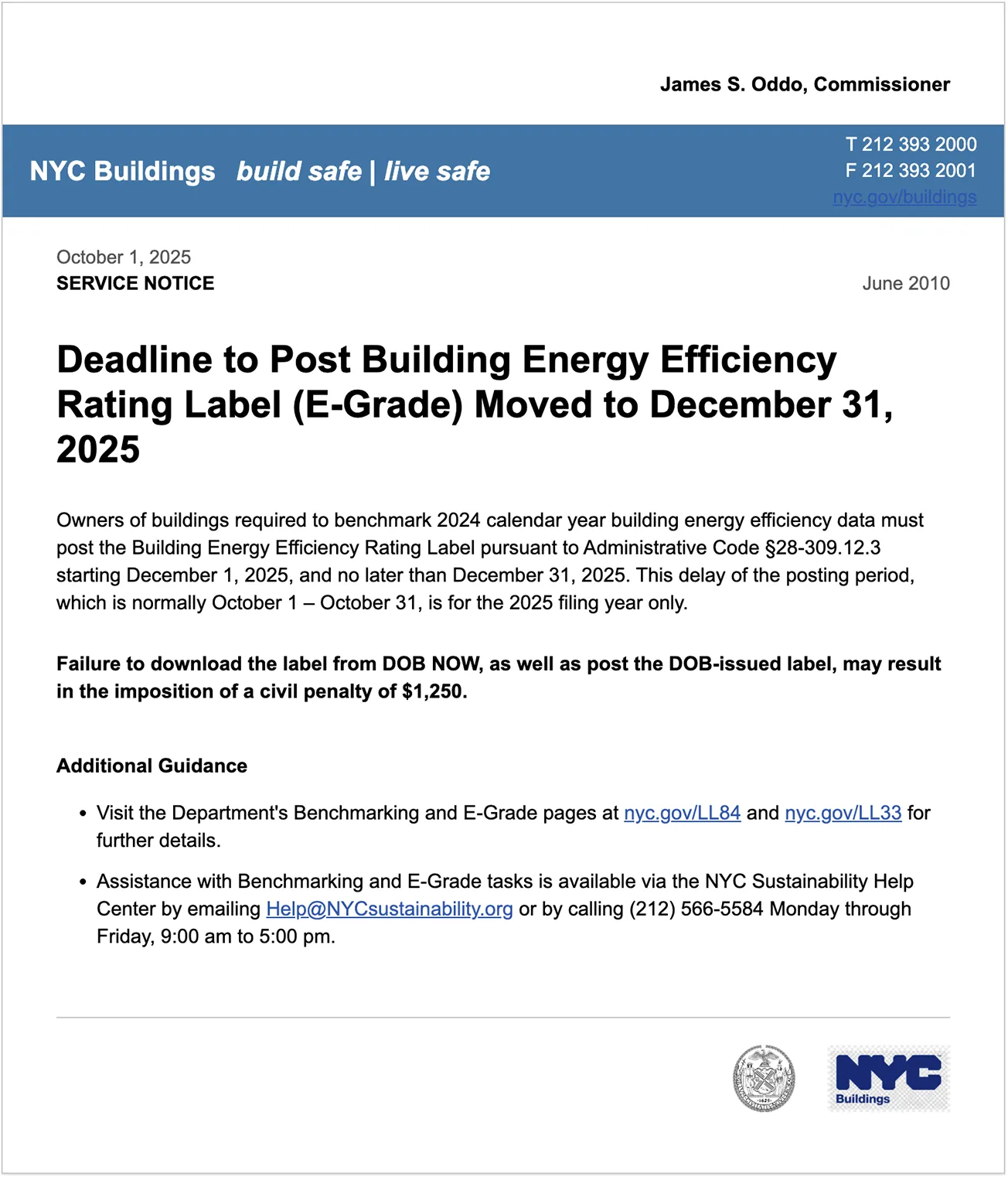
Every New York City building over 25,000 square feet must post its energy-efficiency label near each public entrance by October 31, 2026. Grades are posted in DOB NOW on October 1. Missing the deadline results in the Department of Buildings issuing a $1,250 fine and a violation.
Your grade is a direct readout of the ENERGY STAR Portfolio Manager score in your Local Law 84 (LL84) benchmarking submission, which is what makes Local Law 33 (LL33) and Local Law 95 (LL95) different from most compliance obligations: it publishes the result. Tenants, lenders, and prospective buyers read it on the way in.
About 75% of covered buildings are expected to carry a C or a D. Read your letter against that. A C is not the bad news most owners take it for, and an A in this system is genuinely rare.
Who Has to Post a Grade?
Every building over 25,000 square feet in total floor area. If your property is on the Department of Buildings covered buildings list for benchmarking, you post a label, whether or not you filed your benchmarking data on time.
Buildings that did not submit the required benchmarking information receive an F. Buildings that are exempt, or that cannot obtain a Portfolio Manager score, receive an N. That second category includes properties where a data center, television studio, or trading floor occupies more than 10% of gross floor area, some mixed-use buildings that do not meet Portfolio Manager’s requirements for a score, and multifamily buildings with fewer than 20 units.
Where Does The Label Have to Go?
Near each public entrance, in a conspicuous location, either externally or internally, at a vertical height of no less than 4 feet and no more than 6 feet from the ground. There is no horizontal restriction. The label must be visible to the public and cannot be defaced, marred, camouflaged, or hidden from view.
Two details catch people out. The label stays up all 12 months and should be replaced each year with the latest issued version. A street-level retail store with an entrance exclusive to that store does not need its own label. However, a retail entrance that also leads into the building lobby does.
What Do The Grades Actually Mean?
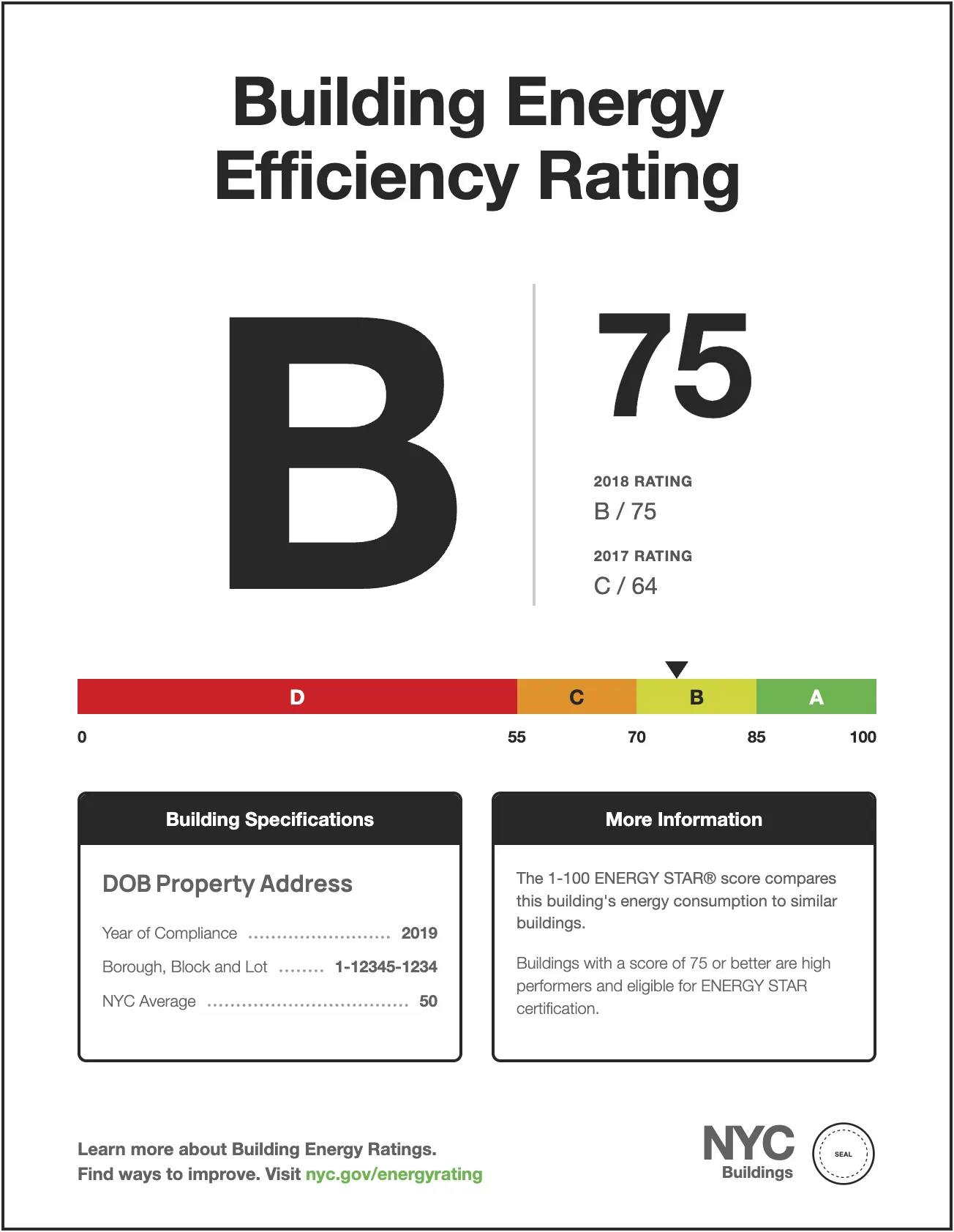
| GRADE | ENERGY STAR PORTFOLIO MANAGER SCORE |
|---|---|
| A | 85 and above |
| B | 70 to 84 |
| C | 55 to 69 |
| D | 54 and below |
| F | Required benchmarking information not submitted |
| N | Exempt, or a score is not feasible to obtain |
The score behind the letter is a percentile. A score of 67 means your building performs better than 67% of comparable buildings in Portfolio Manager, which is a ranking against everyone else rather than a measurement against a fixed standard. The distinction matters.
That distinction is why a D tells you less than most owners assume. The D band runs from 1 all the way to 54, so it holds a building three points from a C alongside a building with a genuine systems problem. Two properties can post the same letter and need completely different work. The grade is the headline. Your benchmarking data is the story.
The Portfolio Manager score also covers the whole building. Common amenity space, ground-floor commercial, and energy that residential tenants pay for directly all land in the same number. A building with a large amenity floor, a 24-hour gym, or a commercial tenant running late is measured on all of it, whether or not the owner pays those bills.
What Happens if You Miss October 31?
An annual fine of $1,250 and a DOB violation. The fine recurs every year the label is missing, so a building that goes three years without posting has paid $3,750 for a document that costs nothing to print.
One procedural point worth putting on a calendar: print the grade from the DOB NOW portal no later than October 31, 2026. Grades are issued starting October 1, which leaves 31 days to pull the label, print it, and get it mounted at every public entrance in the portfolio. For an owner with 40 buildings, that is not an afternoon.
Can You Improve The Grade You Get?
Yes, but not this year’s. The label going up on October 31, 2026 was determined by the benchmarking data you filed in May, and that number is fixed. What you do between now and next spring can influence your 2027 grade.
Start with the data. Three things are worth checking before anything else: the gross square footage on file, the unit and bedroom counts, and whether every meter made it into the submission, including any the utility renumbered or moved onto a new account mid-year. None of that requires capital, and all of it moves the score. Your grade is only ever as good as what you filed, so an error in the LL84 submission becomes an error on the sign in your lobby.
After the data, look at your most recent Local Law 87 (LL87) energy audit. The measures flagged there are usually the ones that move an ENERGY STAR score: heating controls, domestic hot water, and envelope work. Check the date on it. If the audit is several years old, the building has changed underneath the findings.
The same measures do double duty. Local Law 97 (LL97) caps greenhouse gas emissions rather than scoring energy use, so the two laws are not measuring the same thing – but the work that raises a grade is largely the work that lowers an emissions total. Owners planning against the 2030 LL97 limits are already buying the grade improvement. Sequencing the two together costs less than treating them as separate projects.

How Bright Power Helps
We have benchmarked properties continuously since 2009 and file more than 200 Local Law 87 submissions a year, so the data problems behind most disappointing grades are ones we have seen before. EnergyScoreCards tracks utility data across a portfolio year-round, which is what makes a benchmarking error visible in March instead of October. That timing is the whole point.
For owners managing the full NYC filing calendar, our NYC local law compliance team runs LL84, LL87, LL33/95 and LL97 as one process rather than four.
Before October 31
Grades post in DOB NOW on October 1, 2026. Labels must be up at every public entrance by October 31, 2026, and printed no later than that date. If the grade you pull does not match the building you know, the correction belongs in your benchmarking data now, well ahead of the May 2027 filing that sets next year’s letter.
Request A ConsultationFrequently Asked Questions
Where exactly does the energy grade label have to be posted?
Near each public entrance, in a conspicuous location, at a vertical height between four and six feet from the ground. It can be posted internally or externally, and there is no horizontal restriction. The label must stay visible year-round, must not be defaced or covered, and must be replaced annually with the latest issued version.
What is the fine for not posting a building energy grade in NYC?
Failing to post the label by October 31 will result in an annual fine of $1,250 and a Department of Buildings violation. The fine applies each year the label is missing. Buildings that did not submit the benchmarking information behind the grade receive an F on the label itself.
Does a low energy grade affect Local Law 97 compliance?
They are separate filings measured differently. The grade reflects an ENERGY STAR Portfolio Manager score based on energy use, while Local Law 97 (LL97) caps greenhouse gas emissions and penalizes buildings that exceed their limits. The same improvements usually move both, so a grade strategy and an LL97 capital plan are worth building together.
Last reviewed September 24th, 2026